The Fundamentals Gap: What Youth Athletes Are Missing

Why the best thing you can do for your athlete has nothing to do with their sport
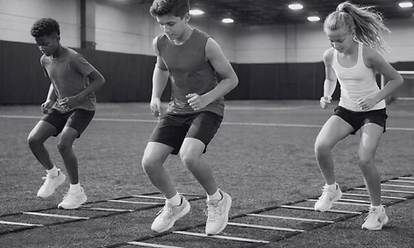
Walk into almost any youth sports environment and you will see kids who are incredibly skilled at their sport. They can strike a ball, handle a stick, shoot, pass and execute drills they've practiced hundreds of times.
But ask that same athlete to land on one leg and control it. Ask them to decelerate without their knee collapsing inward. Ask them to squat, hinge, brace or change direction efficiently.
Sometimes, that is where things start to fall apart. That is what I call the fundamentals gap.
As a Certified Athletic Development Specialist (CADS-IYCA), it's one of the biggest things I look for when working with young athletes. It usually has nothing to do with a lack of talent or effort. They simply have not been given enough time to develop the physical foundation that their sport skills are being built on.
WE ARE BUILDING SKILL BEFORE WE BUILD THE ATHLETE
Youth sports have become incredibly sport-specific. More practices. More private lessons. More travel teams. More tournaments. More touches on the ball.
The idea makes sense. If your child wants to become better at soccer, they should play more soccer.
To a point.

But there is only so much sport-specific work you can stack on top of an athlete who does not yet have the strength, coordination, mobility or body control to support it.
And newer research continues to raise concerns about early specialization. A 2026 systematic review and meta-analysis found that youth sport specialization was associated with roughly twice the odds of injury, although the researchers also noted that risk varies depending on the sport and participation environment.
That does not mean kids should not take their sport seriously. It means developing the athlete should be part of taking the sport seriously.
THE INJURY NUMBERS MATTER
Youth sports injuries are not rare, and the research around specialization and injury has become increasingly difficult to ignore. A 2025 review of 93 studies involving more than 62,000 athletes found that early sport specialization was associated with increased injury risk and poorer outcomes in several measures of physical function and performance.
ACL injuries are another major concern. An analysis of U.S. high school sports data found that the average annual ACL injury rate increased 25.9% across five three-year periods between 2007 and 2022.
And while specialization is not the only reason athletes get hurt, the newest research continues to show an association between higher specialization and greater injury risk.
So the answer is not simply "play less." It's to make sure some of an athlete's training time is actually spent developing the body doing the playing.
SO WHAT DO I ACTUALLY MEAN BY "FUNDAMENTALS"?
I am not talking about stretching for five minutes before practice or throwing together a random circuit. I mean deliberately developing the physical qualities that show up in almost every sport.
MOVEMENT MECHANICS
Squat. Hinge. Lunge. Push. Pull. Brace. Rotate. Jump. Land.
These are basic movement skills, but they matter. Before I ask an athlete to perform something quickly or under heavy load, I want them to understand the position first. We learn the movement, build control, add resistance when appropriate and eventually add speed. The goal is not perfect movement. The goal is giving athletes more options and more control over their bodies.
2. STRENGTH AND FORCE ABSORPTION
When people hear "strength training," they usually think about how much weight someone can lift. For athletes, strength is also about what happens when force comes back into the body.

Can you land?
Can you stop?
Can you absorb contact?
Can you control your body when you plant your foot to change direction?
Properly coached resistance training is considered safe and effective for young athletes. We are not trying to turn a 12-year-old into a powerlifter. We're progressively building the strength their sport is eventually going to demand from them anyway.
3. MOBILITY
Athletes do not just need flexibility. They need usable range of motion.
There is a big difference between being able to get into a position and being able to control that position while running, jumping, cutting or lifting.
This becomes especially important as kids grow. Their bodies are changing quickly, and movement that felt natural six months ago may suddenly feel completely different.
4. SPEED
Telling a kid to "run faster" is not speed training. Acceleration, posture, arm action, ground contact and sprint mechanics can all be coached.
Speed is a skill.
And whether an athlete plays soccer, lacrosse, basketball, football, field hockey or almost any other field or court sport, getting faster makes them better at their sport without spending another hour practicing the sport itself.
5. POWER
Strength is useful.
Being able to express that strength quickly is what makes it athletic.
Power is the product of strength (force) and speed (velocity).
Jumping, bounding, throwing and accelerating all require an athlete to produce force quickly. Properly progressed plyometrics help athletes develop that ability while also teaching them how to land and control force.
6. AGILITY AND CHANGE OF DIRECTION

Agility is not just running through cones. Sport is reactive.
An opponent moves. The ball changes direction. Space opens. An athlete has to recognize what happened, slow themselves down and go somewhere else.
That means we need to teach athletes how to brake just as much as we teach them how to accelerate. Then we can add reaction and decision-making.
7. COORDINATION AND BALANCE
This is one of the most overlooked pieces of athletic development.
Single-leg control, rhythm, spatial awareness and the ability to learn new movement patterns all influence how quickly an athlete can pick up more complicated skills later. The better an athlete understands their body, the easier it becomes to coach everything else.
8. WORK CAPACITY
Athletes need to be able to maintain quality movement when they are tired.
It's easy to land well during the first five minutes of practice. It's much harder late in a game when your legs are heavy and you are reacting at full speed.
Conditioning is not just about being able to run longer. It's about building an athlete who can continue producing quality movement as fatigue increases.
WHAT THIS LOOKS LIKE IN MY SESSIONS
We're not doing ball skills. We're not doing stick work. Your sport coach already handles that, and they should.
My job is to develop the athlete underneath the soccer player, lacrosse player, basketball player or gymnast. We work on movement quality, strength, speed, power, coordination, balance, deceleration and overall athleticism. The goal is that when athletes go back to their sport, they have a bigger physical toolbox to work with.
They are stronger.
They move better.
They understand how to use their bodies.
They can accelerate and decelerate more effectively.
And ideally, they are better prepared for the physical demands their sport is going to place on them.
"But isn't this taking time away from their sport?"
Technically, yes. And that's okay.
Not every available hour needs to become another hour of the same sport. In fact, the research does not support the idea that specializing as early as possible is necessary for future success in most sports. Reviews of elite and professional athletes have found that many reached high levels after participating in multiple sports when they were younger and specializing later.
There is also the bigger picture.
The Aspen Institute's latest national youth sports survey found that the average former athlete stopped participating in organized sports at 12.93 years old, with the biggest drop-off happening between ages 12 and 14.
We want athletes who are still healthy, developing and enjoying movement when they are 15, 16 and 17. Not athletes who were incredible at 11 and burned out, plateaued or were constantly injured by 14.
The goal is not to create the best 12-year-old. The goal is to give that 12-year-old the physical foundation to keep getting better.
BUILD THE ATHLETE, THEN BUILD THE PLAYER
Sport-specific coaching matters. Technical reps matter. Practice matters.
But all of those things work better when there is a capable athlete underneath them.
I work with youth athletes in private and small-group settings to develop the physical qualities their sport often assumes they already have.
Every session is built around the athlete in front of me: their age, training history, sport, movement ability and current stage of development.
If your athlete keeps dealing with the same injuries, feels like they have plateaued, needs to become stronger or faster, or you simply want to give them a better physical foundation from the start, reach out.
Private and small-group youth athletic development sessions are now open.
Email: ejdfitnesscoaching@gmail.com
SOURCES
Aspen Institute Project Play, National Survey of Youth and Sports, 2026
Lai et al., Association between youth athletes' sports specialization and injuries: a systematic review and meta-analysis, PeerJ, 2026
Early Sport Specialization in a Pediatric Population: A Rapid Review of Injury, Function, Performance, and Psychological Outcomes, 2025
Hospital for Special Surgery / National ACL Injury Coalition, High School ACL Injury Analysis
McLellan et al., Youth Sports Specialization and Its Effect on Professional, Elite, and Olympic Athlete Performance, Career Longevity, and Injury Rates, 2022

Comments